

 Table of Contents
Bring simplicity to your field service operations.
Our list of integrations is updated frequently. Explore each integration in its own separate page for more information.
Spare parts sit at the centre of operational continuity. When equipment fails, the availability of a single component often determines whether the issue is resolved within hours or escalates into days of lost productivity. In European service environments where response times and service level agreements are tightly scrutinised, poor inventory control quickly translates into financial loss. Excess stock ties up capital and warehouse space, while missing parts extend repair cycles and reduce asset reliability. The real question for any operations leader is how to balance availability with cost, and how that balance directly reduces mean time to repair and protects margins.
Spare parts do not behave like standard retail stock. Demand is irregular, often driven by unexpected failures rather than predictable consumption patterns. A low-cost component can carry disproportionate operational importance, especially in sectors such as utilities, heavy machinery, or industrial servicing where downtime has cascading effects.
Traditional just-in-time thinking falls short in this context. A purely lean approach increases exposure to supply chain delays, which remain a persistent issue across EU markets due to cross-border logistics and supplier dependencies. Instead, businesses adopt a more deliberate stocking strategy, one that reflects the criticality of each component rather than its price alone.
The distinction between critical spares and general consumables becomes essential. Failing to classify parts correctly leads to two common problems. Either warehouses become overloaded with low-impact items, or high-risk components are unavailable when needed most. Both outcomes weaken service delivery and inflate operational costs.
Effective spare parts management begins with structured classification. Value-based analysis helps identify which items carry the highest financial weight, while criticality-based assessment focuses on operational impact. Combining these perspectives allows teams to prioritise parts that are both expensive and essential, as well as those that are inexpensive yet vital to system uptime.
Long lead times must also be factored into stocking decisions. Parts sourced from outside the EU or those tied to specific manufacturers require additional buffer to mitigate delays. Without this foresight, procurement cycles become reactive and unpredictable.
Regular audits play a crucial role in maintaining balance. Over time, warehouses accumulate obsolete components linked to retired equipment or outdated service contracts. These items silently consume capital and space. Removing them not only frees resources but also improves visibility for active inventory.
A data-driven approach transforms inventory from a static cost centre into a controllable system. Historical usage patterns, failure rates, and repair frequency provide insight into future demand, allowing organisations to refine stocking levels with greater precision.
Parts tracking is where strategy meets execution. Consistency in naming conventions reduces confusion across teams and locations, especially in multilingual environments common across Europe. Without standardisation, the same component may be recorded under several variations, creating discrepancies in stock records.
Barcode and QR-based systems significantly reduce manual errors. They allow technicians to register usage instantly, eliminating delays between physical consumption and system updates. This real-time accuracy is critical in avoiding duplicate orders or unexpected shortages.
Secure storage is equally important. Uncontrolled access often leads to so-called phantom inventory, where systems show available stock that no longer exists physically. Establishing clear procedures for part withdrawal ensures accountability and traceability.
Technician behaviour is a defining factor. Even the most advanced system fails if field teams bypass proper check-out processes. Training must emphasise that accurate reporting is not administrative overhead but a direct contributor to faster repairs and fewer repeat visits.
Improved organisation has a measurable effect on performance. When technicians spend less time searching for parts, they complete jobs faster and increase first-time fix rates, which directly impacts customer satisfaction.
Manual logs and fragmented spreadsheets cannot support the level of coordination required in modern service operations. As teams grow and operate across multiple sites, the risk of data inconsistency increases sharply.
Digital systems bring clarity by centralising information. Stock levels, usage history, and availability become visible to both field technicians and office staff in real time. This shared visibility reduces miscommunication and prevents unnecessary procurement actions.
Historical data becomes a strategic asset. Patterns in part usage reveal underlying issues such as recurring failures or inefficient maintenance practices. With this insight, organisations can shift from reactive repairs to more predictive approaches.
Digitisation also reduces administrative burden. Automated updates and synchronised records eliminate repetitive manual tasks, allowing teams to focus on operational efficiency rather than data reconciliation.
Within a field service environment, inventory cannot operate in isolation. It must be directly connected to work execution. This is where Frontu acts as a central coordination layer, linking parts availability with ongoing service activities.
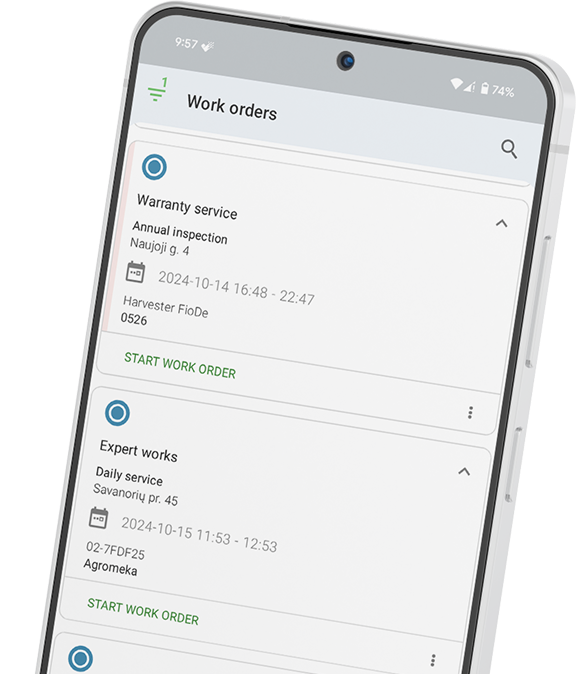
Technicians working in the field can check stock levels before arriving on site, ensuring they carry the right components for the job. As parts are used, updates are recorded instantly through mobile devices, keeping the entire organisation aligned without delays.
Managers gain a clear view of inventory movement across locations. This visibility makes it possible to identify inefficiencies such as overstocked depots or recurring shortages in specific regions. Procurement decisions become grounded in real usage data rather than assumptions.
Frontu also supports better control over parts leakage. By tracking where and how components are consumed, organisations can detect patterns that indicate waste, misuse, or process gaps. Addressing these issues leads to tighter cost control and more predictable operations.
The platform does not simply record inventory data. It integrates that data into the broader service workflow, ensuring that spare parts management contributes directly to faster repairs and improved service delivery.
Managing spare parts effectively is not about storing more or less. It is about ensuring availability aligns with operational risk. The right part, in the right place, at the right time, becomes a competitive advantage rather than a logistical challenge.
Organisations that treat inventory as a strategic function achieve higher service levels and lower downtime. Those that rely on fragmented systems and outdated practices continue to face unnecessary delays and hidden costs.
The shift towards optimisation begins with reliable data and integrated tools. Once visibility improves, decision-making follows. The real cost lies not in investing in better systems, but in continuing without them. Over the course of a year, even small inefficiencies compound into significant financial impact, while a structured approach unlocks measurable gains in both performance and profitability.
ABC analysis classifies inventory based on value. High-value items receive the most attention due to their financial impact, while lower-value items are managed with less intensity. This helps prioritise control efforts where they matter most.
Critical parts are identified through an assessment of their impact on operations. VED analysis categorises items based on whether they are vital, essential, or desirable, with focus placed on those that would cause significant downtime if unavailable.
Human error remains the primary cause. Delayed updates, inconsistent naming, and lack of real-time reporting lead to mismatches between recorded and actual stock levels.
Spending should reflect the balance between carrying costs and the financial impact of downtime. Investing in critical components often prevents far greater losses associated with halted operations.
Real-time tracking reduces time spent locating parts and waiting for deliveries. This enables technicians to complete jobs more efficiently and improves first-time fix rates.
Automated thresholds trigger replenishment at predefined levels, reducing manual intervention and ensuring stock is maintained without over-ordering.
Frontu provides visibility across all locations, allowing teams to monitor stock levels, transfer parts between sites, and coordinate usage without losing accuracy or control.




Our list of integrations is updated frequently. Explore each integration in its own separate page for more information.
Link copied!
Join 10,000+ FSM leaders. Subscribe to our monthly expert-led newsletter. We find and report on case studies, success stories and playbooks that are working out there right now.