

 Table of Contents
Bring simplicity to your field service operations.
Our list of integrations is updated frequently. Explore each integration in its own separate page for more information.
Not all work orders carry the same weight, yet many maintenance operations still treat them as if they do. When every request enters the system on a first come, first served basis, the result is predictable: critical assets wait, technicians firefight, and resources are misallocated. Over time, this creates operational noise rather than control.
Work order prioritisation introduces structure where there is usually ambiguity. It connects daily maintenance decisions with broader business outcomes, especially in environments where uptime directly affects revenue. A clear prioritisation model answers a simple but often overlooked question: what happens to your most valuable production lines when everything is treated as equally important?
A structured triage process ensures that the right work is done at the right time. It shifts maintenance from reactive execution to deliberate decision making, where asset importance, risk, and operational impact define what gets attention first.
Maintenance teams often operate under pressure, but not all pressure is equal. Urgent tasks demand immediate action, typically linked to safety risks, operational stoppages, or compliance breaches. Important tasks, on the other hand, are those that protect long term reliability, such as inspections, servicing, and planned interventions.
The challenge is that urgent work tends to dominate the schedule. Teams fall into a constant cycle of reactive repairs, where preventive activities are repeatedly postponed. This creates a compounding effect. Missed inspections lead to failures, which generate more urgent work, further reducing the time available for planned maintenance.
A balanced workload is essential. Organisations that track the split between reactive and planned work often uncover an uncomfortable truth: a high proportion of labour is spent responding to avoidable issues. This imbalance does not only affect asset performance, it also impacts technician morale. Working in constant response mode reduces predictability, increases stress, and limits the ability to improve systems over time.
The goal is not to eliminate urgent work, which is unrealistic, but to prevent it from dominating operations. Prioritisation frameworks allow teams to protect time for important tasks while still responding effectively when genuine emergencies arise.
A reliable prioritisation system depends on clear criteria. Without defined rules, prioritisation becomes subjective and inconsistent across teams or regions.
Safety risk is the primary factor. Any issue that threatens personnel or violates regulatory requirements must automatically rise to the top of the queue. In the EU context, where compliance standards are strict and enforced, this is non negotiable.
Asset criticality forms the backbone of prioritisation. Not all equipment contributes equally to operations. Some assets directly influence production throughput or service delivery, while others play a supporting role. Understanding this hierarchy allows maintenance teams to focus effort where downtime would have the highest cost.
Environmental impact is another key consideration. Equipment failures that risk spills, emissions, or contamination carry both financial and reputational consequences. These risks must be embedded into the prioritisation logic rather than treated as secondary concerns.
There is also the question of escalation. A minor issue today can become a major failure tomorrow if left unresolved. A strong prioritisation model accounts for the likelihood and consequence of deterioration, not just the current state of the asset.
When these factors are combined into a structured model, the concept of what is a work order becomes more than a simple task description. It becomes a decision point with a defined priority level that guides execution in the field.
Most maintenance organisations adopt a tiered system to standardise how work is classified. While terminology may vary, the logic remains consistent.
Emergency work represents situations where immediate action is required. This typically includes safety hasards, complete asset failure, or regulatory breaches. Response expectations are measured in minutes or hours, and resources are redirected without delay.
High priority work covers issues that significantly affect operations but do not pose immediate danger. These tasks require rapid scheduling and often take precedence over planned activities, though not at the expense of safety critical work.
Medium priority work includes defects or inefficiencies that should be addressed within a defined timeframe to prevent escalation. These tasks are often scheduled within existing maintenance windows.
Routine or project work sits at the lowest level. These tasks support long term improvements, upgrades, or non critical repairs. They are planned in advance and executed when capacity allows.
The value of this structure lies in clarity. When priority levels are well defined and consistently applied, it becomes easier to manage expectations across departments. It also reduces the common scenario where every stakeholder believes their request is urgent. Standardisation creates accountability and improves coordination between office teams and field technicians.
Manual prioritisation is time consuming and prone to inconsistency, especially in organisations handling large volumes of work orders across multiple locations. This is where digital systems play a decisive role.
Frontu enables maintenance teams to embed prioritisation logic directly into their workflows. Managers can assign default priority levels based on asset type, job category, or predefined rules. This reduces the need to evaluate each request individually and ensures consistency from the moment a work order is created.
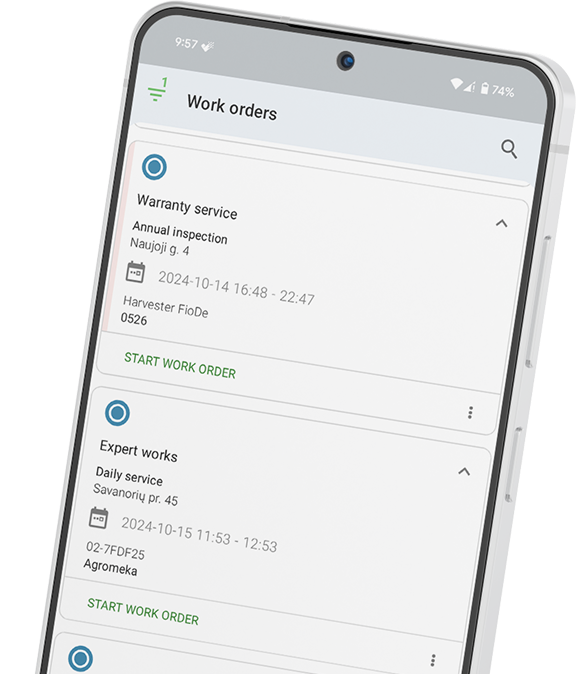
The platform also supports intelligent scheduling, where priority levels influence how tasks are assigned and sequenced. Technicians using the mobile application see their most critical jobs first, regardless of when the request was submitted. This removes ambiguity and allows field teams to focus on execution rather than decision making.
Another operational advantage is time savings. Maintenance managers often spend a significant portion of their day reviewing, sorting, and reassigning tasks. Automating triage frees up this time, allowing them to focus on optimisation, resource planning, and continuous improvement.
In practice, this means fewer delays, better alignment between planning and execution, and a more predictable service operation.
Work order prioritisation is not an administrative exercise. It is a control mechanism that determines how effectively an organisation uses its maintenance resources.
Without it, operations drift into reactive behaviour, where effort is driven by urgency rather than impact. With it, maintenance becomes aligned with business objectives, supporting uptime, compliance, and long term asset performance.
The shift requires moving away from subjective judgement and towards a structured, data driven approach. A well defined priority index reduces uncertainty, improves coordination, and creates a working environment where both assets and technicians perform at their best.
For organisations aiming to move from reactive cost centres to proactive value drivers, evaluating how a modern field service management system supports prioritisation is a practical next step.
When several high risk situations occur simultaneously, prioritisation shifts to situational triage. Teams must assess safety impact, operational dependency, and available resources. In some cases, this means reallocating technicians, delaying less critical emergencies, or involving external support to stabilise operations quickly.
Preventive maintenance should not automatically be deprioritised. Consistently delaying it increases the likelihood of failures, which then appear as urgent repairs. A balanced system protects time for planned work to reduce future disruptions.
A Work Priority Index is a scoring model that assigns numerical values to factors such as safety risk, asset criticality, and operational impact. The combined score determines the priority level, making the process objective and repeatable.
This is typically managed through SLA tracking and reporting within a field service management system. Metrics such as response time, completion time, and backlog by priority level provide visibility into performance.
Poor prioritisation often leads to extended downtime on high value equipment. This results in lost production, increased repair costs, and potential contractual penalties, especially in industries with tight delivery commitments.
Yes. When priority is clear, the right resources are allocated faster, and technicians arrive prepared. This reduces delays in diagnosis and repair, leading to shorter Mean Time to Repair.
Systems like Frontu allow supervisors to adjust priorities manually when needed. This ensures flexibility while maintaining the benefits of automation.




Our list of integrations is updated frequently. Explore each integration in its own separate page for more information.
Link copied!
Join 10,000+ FSM leaders. Subscribe to our monthly expert-led newsletter. We find and report on case studies, success stories and playbooks that are working out there right now.