

 Table of Contents
Bring simplicity to your field service operations.
Our list of integrations is updated frequently. Explore each integration in its own separate page for more information.
Unmonitored machinery sitting on dispersed jobsites carries a level of financial exposure that many construction firms underestimate. An excavator that disappears overnight or a loader that cannot be located in time for the next phase of work does more than disrupt a schedule. It creates cascading delays, idle crews, contractual penalties, and lost revenue. What once was considered a basic anti-theft measure has developed into a critical operational layer. GPS tracking now acts as a continuous stream of location and usage data that supports daily decisions across construction businesses.
Real-time visibility changes how companies understand asset utilisation. Instead of relying on assumptions or manual logs, managers can see exactly where each unit is, how long it has been active, and whether it is contributing to productive work. This directly answers a pressing question many operations leaders face: what is the actual cost of downtime when equipment is missing, underused, or sitting idle across multiple sites?
Construction equipment theft remains a persistent issue across Europe, particularly on remote or temporarily secured sites. GPS tracking introduces both deterrence and recovery capability. The presence of a tracker alone reduces the likelihood of theft, while real-time positioning allows rapid response if an incident occurs. Recovery time is shortened, and losses are significantly reduced.
However, security is only one part of the picture. Daily operations benefit just as much. Technicians and operators no longer waste time searching for machinery across large or fragmented sites. That lost time, often overlooked, accumulates into substantial inefficiency over weeks and months. With precise location data available instantly, equipment allocation becomes deliberate rather than reactive.
Project scheduling also improves when asset visibility is centralised. Managers can ensure that the correct machines are positioned exactly where they are needed before work begins. This reduces delays caused by equipment shortages or misallocation. It also supports accuracy in heavy equipment software, where planning depends on real, not assumed, asset availability.
Beyond protection, GPS tracking provides operational insights that directly influence cost control. Geofencing allows businesses to define digital boundaries around jobsites. If a machine moves outside these boundaries outside working hours, alerts are triggered immediately. This layer of control protects assets without requiring constant manual supervision.
Tracking engine hours and idle time reveals inefficiencies that would otherwise remain hidden. Excessive idling contributes to fuel waste, increased wear, and unnecessary emissions. By identifying patterns of underuse or misuse, companies can adjust operator behaviour and reduce fuel consumption across the fleet.
Maintenance planning also becomes more precise. Instead of relying on estimated service intervals, businesses can schedule maintenance based on actual usage data. This ensures that equipment is serviced when needed, not too early and not too late, which extends asset lifespan and reduces unexpected breakdowns.
Location-based data also introduces clarity into internal billing processes. When equipment is shared between projects, GPS data provides a verifiable record of where and when each asset was used. This improves billing accuracy and removes disputes between departments or project managers regarding equipment allocation.
The effectiveness of a tracking system depends heavily on the hardware chosen. Construction environments demand durable solutions that can withstand dust, vibration, moisture, and temperature fluctuations. Battery-powered trackers offer flexibility for non-powered assets such as trailers or attachments, while hardwired units provide continuous data for heavy machinery.
Update frequency is another critical factor. High-frequency tracking ensures that data reflects real-world conditions without delay. This is particularly important when coordinating equipment across multiple sites or responding to unexpected changes.
Yet hardware alone delivers limited value without integration. The real advantage emerges when GPS data feeds directly into a broader operational system. When connected to field service management software, location data becomes actionable. It informs dispatching decisions, supports maintenance scheduling, and aligns asset availability with workforce planning.
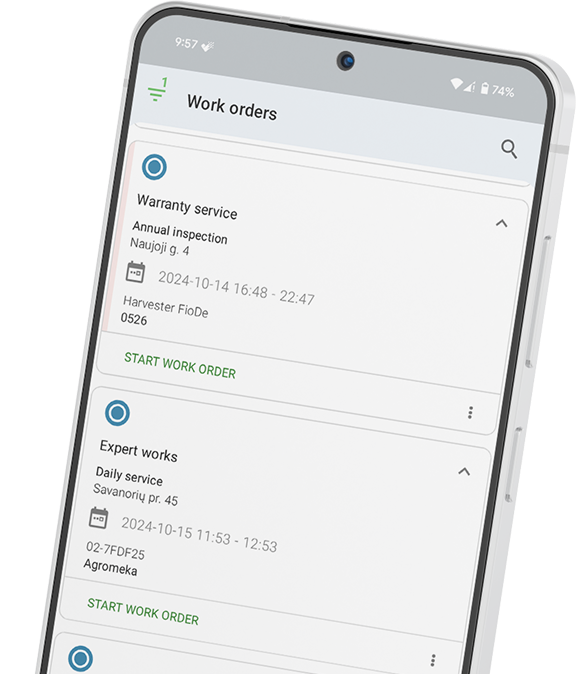
Construction firms and equipment dealers require more than isolated tools. They need a unified environment where assets and people are managed together. Frontu addresses this by combining technician management with equipment tracking into a single platform.
With a consolidated view of technician availability, job progress, and equipment location, operational decisions become faster and more accurate. Dispatchers no longer rely on fragmented information or multiple systems. Instead, they can assign work based on real-time conditions across the entire operation.
Frontu also strengthens maintenance workflows. By using engine hour data captured through GPS tracking, the platform can automate service alerts and ensure that equipment is maintained according to actual usage. This reduces downtime and prevents costly failures.
Combining asset tracking with automated dispatching creates measurable return on investment. Travel time is reduced, equipment utilisation increases, and administrative overhead decreases. More importantly, the organisation operates with a level of clarity that is difficult to achieve when systems are disconnected.
GPS tracking has moved from optional to essential for construction businesses operating across multiple sites. It delivers more than security. It creates transparency, improves utilisation, and supports informed decision-making across the entire operation.
The goal is not simply to know where equipment is located. It is to ensure that every asset contributes fully to productive work while remaining protected at all times. The most effective approach is one where tracking data integrates seamlessly into daily workflows, supporting both field operations and management oversight.
Construction companies that invest in this level of visibility position themselves to operate with greater control, reduced risk, and stronger financial performance. Evaluating current fleet visibility is the first step towards building a more efficient and resilient operation.




Our list of integrations is updated frequently. Explore each integration in its own separate page for more information.
Link copied!
Join 10,000+ FSM leaders. Subscribe to our monthly expert-led newsletter. We find and report on case studies, success stories and playbooks that are working out there right now.