

 Table of Contents
Bring simplicity to your field service operations.
Our list of integrations is updated frequently. Explore each integration in its own separate page for more information.
Digital work order management replaces fragmented paper trails with a single, real-time operating layer that connects technicians, dispatchers, and back-office teams. It is not simply about removing paper. It is about creating a live environment where every task, update, and outcome is visible the moment it happens.
In practice, this shift defines how modern field service businesses operate. When work orders are created, assigned, executed, and closed within one system, decision-making becomes immediate rather than reactive. The real question for any service business is not whether paper is inconvenient. It is how much those small inefficiencies compound into lost revenue, delayed billing, and missed service opportunities over the year.
Manual work order processes tend to fail quietly. A technician completes a job, writes notes on paper, and hands them in at the end of the day or even the end of the week. By the time that information reaches the office, the operational context is already outdated.
Paper forms are often misplaced, handwriting is misinterpreted, and key job details never make it into the system. This creates friction across the entire workflow. Billing is delayed because finance teams wait for confirmed job completion. Customers become frustrated when service updates are unclear or late. Managers lack reliable historical data to assess asset performance or recurring issues.
There is also a hidden operational cost that many companies underestimate. Administrative staff spend hours re-entering information from paper into spreadsheets or systems that should have been updated in real time. That duplication of effort is not visible on a balance sheet, but it directly reduces capacity and slows down the entire service cycle.
When teams calculate how many hours per week are spent on these repetitive tasks, the scale of inefficiency becomes difficult to justify.
A modern digital work order platform is built around real-time coordination. Scheduling tools allow dispatchers to assign jobs dynamically, adjusting workloads based on urgency, technician availability, and location. Technicians receive updates instantly on their mobile devices, eliminating the need for constant phone calls or manual coordination.
Mobile capability is essential, not optional. Technicians must be able to access job details, update statuses, log time, and capture evidence such as photos or signatures directly on site. Offline functionality plays a critical role in European markets where service work often takes place in rural areas, industrial zones, or underground facilities with limited connectivity. Data is captured locally and synchronised automatically once a connection is restored.
Integration is another defining factor. A strong platform connects work orders with inventory systems, customer records, and asset histories. This creates a complete operational view where every job is linked to the broader service lifecycle. Without this level of integration, even digital tools can become isolated and limit their own impact.
The most effective platforms position themselves not as standalone tools but as the operational core of field service management.
When work order management becomes digital, visibility improves immediately. Managers can track job progress in real time, identify delays, and respond before issues escalate. This level of transparency changes how decisions are made, shifting from reactive problem-solving to proactive optimisation.
Speed is another direct outcome. Technicians arrive on site with full job context, including service history, required parts, and customer details. This increases first-time fix rates and reduces repeat visits, which are often one of the most expensive inefficiencies in field service operations.
Customer experience also improves. Digital proof of work can be generated instantly, allowing clients to receive confirmation, reports, and documentation without waiting days for manual processing. In industries where compliance and traceability are critical, this immediacy becomes a competitive advantage rather than a convenience.
From a financial perspective, the impact compounds quickly. Faster job completion, reduced administrative overhead, and shorter billing cycles all contribute to stronger cash flow. When productivity increases even modestly, the effect on quarterly revenue becomes significant, especially for businesses managing large volumes of service jobs across multiple regions.
Frontu approaches digital work order management as a practical operational upgrade rather than a complex transformation. The platform is designed to integrate directly into existing workflows, allowing businesses to transition without disrupting day-to-day operations.
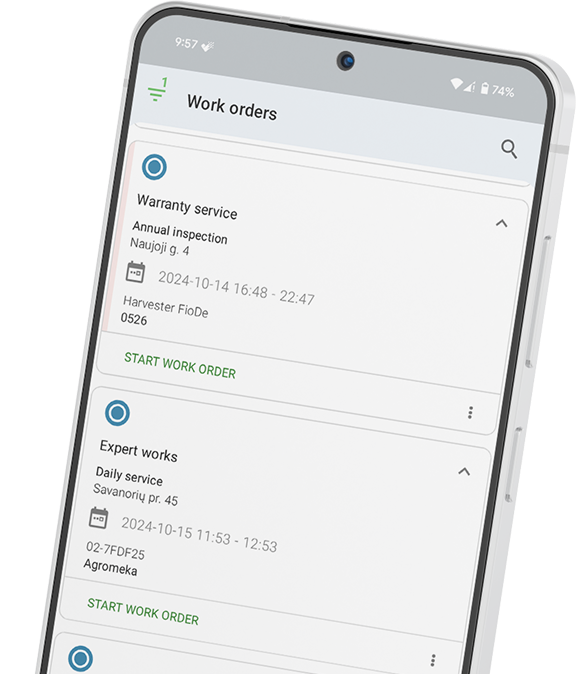
Technicians use a unified mobile application where they can log working hours, capture images, complete checklists, and collect customer signatures in one place. This eliminates the need for separate tools and ensures that every action is recorded within the same system.
For managers, the value lies in real-time oversight. Work order statuses, completion times, and service level performance can be monitored as they happen. This visibility allows teams to identify bottlenecks, optimise routes, and allocate resources more effectively across different service areas.
The reporting capabilities extend beyond basic tracking. Businesses can analyse performance trends, measure technician efficiency, and ensure compliance with contractual obligations. This level of insight supports better planning and stronger client relationships, particularly in industries where service reliability is directly tied to long-term contracts.
The result is not just improved efficiency but a measurable shift in how service operations are controlled and scaled.
Digital work order management has moved from being a competitive advantage to a fundamental requirement for service-based businesses. Companies that continue to rely on manual processes are not just slower. They operate with limited visibility, delayed decision-making, and unnecessary operational risk.
The most practical starting point is to review existing workflows and identify where time is lost. Paper-based approvals, delayed reporting, and duplicated data entry are often the first indicators of inefficiency. Addressing these areas with a digital system creates immediate gains that extend across the entire organisation.
The decision to digitise is rarely driven by technology alone. It is driven by the need to maintain service quality, protect margins, and meet rising customer expectations. Businesses that act before inefficiencies lead to client dissatisfaction or operational failure position themselves to grow with greater control.
Testing a modern field service management platform is not a long-term commitment. It is a direct way to understand how much performance is currently left on the table.
An electronic work order is typically a static document, often a PDF or form stored digitally. A digital system manages the entire workflow in real time, connecting creation, assignment, execution, and reporting within one environment.
Technicians can access and complete work orders without an internet connection. The data is stored locally on the device and automatically synchronised with the central system once connectivity is restored.
Yes. Digital systems provide timestamped records, structured data, and secure signatures that cannot be altered without trace. This supports audit requirements and ensures consistent documentation.
Modern platforms are designed with simplicity in mind. Interfaces are intuitive, often resembling familiar mobile applications, which reduces the learning curve even for less technically experienced users.
Delayed reporting creates a gap between job completion and invoicing. This slows down cash flow and increases the risk of missed or incorrect billing, especially when information is incomplete or inaccurate.
Inventory data is integrated into the system, allowing technicians to view available parts, record usage, and update stock levels in real time as part of the work order process.
Yes. Platforms like Frontu allow businesses to replicate and adapt their existing forms digitally, ensuring continuity while improving data accuracy and accessibility.




Our list of integrations is updated frequently. Explore each integration in its own separate page for more information.
Link copied!
Join 10,000+ FSM leaders. Subscribe to our monthly expert-led newsletter. We find and report on case studies, success stories and playbooks that are working out there right now.