

 Table of Contents
Bring simplicity to your field service operations.
Our list of integrations is updated frequently. Explore each integration in its own separate page for more information.
Work order software has moved far beyond spreadsheets and paper logs. In modern field service environments, it acts as the operational backbone that connects dispatchers, technicians, and back office teams in real time. The shift is not simply digital. It is structural. A well implemented system gives full visibility over every job, ensures accountability in the field, and shortens the gap between task completion and invoicing.
The rise of mobile-first operations has changed expectations. Technicians no longer return to the office to report. They complete, document, and close jobs on-site. Decisions are made based on live data rather than assumptions. While there are many tools on the market, the best solution depends on how closely it reflects the realities of your industry rather than how many generic features it lists
Many service businesses across Europe still rely on fragmented processes. Paper forms, spreadsheets, and loosely connected systems create delays that are often invisible until they scale into real costs. A technician may complete a job perfectly, yet billing is delayed because documentation sits in a van or waits for manual entry.
Generic project management tools introduce a different problem. They are designed for office workflows rather than field conditions. They struggle with dynamic scheduling, asset tracking, and real-time updates from technicians operating in remote or low-connectivity environments.
The failure is not just operational. It affects customer experience and revenue flow. Missed updates lead to repeated site visits. Lack of inventory visibility results in incomplete jobs. Dispatchers spend more time coordinating than optimising. Over time, these inefficiencies compound into lost margin rather than isolated incidents.
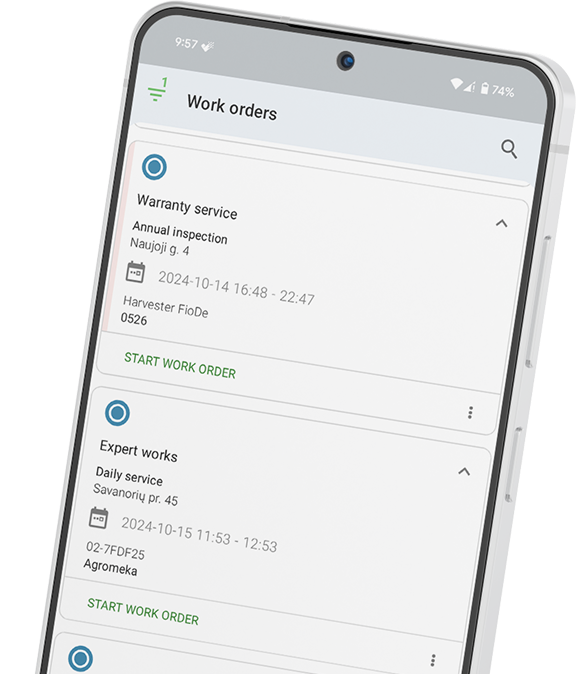
Frontu is designed specifically for field service environments where coordination between office and field teams must be seamless. It removes friction by creating a continuous flow of information between dispatchers and technicians, regardless of location.
Its offline capability ensures that technicians can continue working even in areas with limited connectivity. Data syncs automatically once a connection is restored, which is critical for industries such as heavy equipment servicing or infrastructure maintenance where coverage cannot be guaranteed.
Digital signatures and job documentation happen directly on-site. This removes the delay between job completion and approval, allowing invoices to be issued almost immediately. Integrated inventory tracking reduces the likelihood of return visits, which directly impacts fuel costs and technician utilisation.
From an ROI perspective, the gains are measurable. Reduced travel time through optimised routing, fewer repeated visits due to missing parts, and faster billing cycles all contribute to improved cash flow. More importantly, the system scales with operational complexity. Whether managing a small regional team or expanding across multiple countries, the structure remains consistent without adding administrative burden.
Frontu is particularly strong in sectors such as heavy machinery, HVAC, and facilities management where service workflows are complex and require full lifecycle visibility rather than simple task tracking.
MaintainX is built with industrial maintenance in mind. It focuses heavily on safety procedures, compliance tracking, and structured workflows. For facilities that operate within strict regulatory frameworks, this can be a strong advantage.
The platform handles documentation well, especially when it comes to photo evidence and inspection logs. However, its structure can feel restrictive in environments where service schedules are less predictable. Field service teams that deal with varied and reactive jobs may find it less adaptable compared to solutions designed specifically for dynamic dispatching.
UpKeep positions itself as a CMMS-focused solution, prioritising asset reliability and maintenance scheduling. It excels in environments where equipment uptime is the primary concern.
The distinction becomes clear when comparing it with service-oriented platforms. UpKeep is built around assets, while field service systems like Frontu are built around service delivery. For organisations that require strong coordination between technicians, customers, and logistics, an asset-first approach may not cover the full operational picture.
Jobber is widely used among smaller service businesses such as plumbing, landscaping, and residential HVAC. Its interface is accessible and easy to adopt, making it suitable for teams with limited technical resources.
The limitation appears as the business grows. Larger operations often require deeper reporting, integration with other systems, and more advanced scheduling capabilities. Jobber handles day-to-day operations well but may not provide the level of control needed in more complex environments.
Connecteam offers a broad set of features for managing deskless employees, including communication, scheduling, and basic work order functionality. It is suitable for organisations that need an all-in-one employee app rather than a specialised field service solution.
Work order management is not its primary focus, which means it may lack the depth required for industries where service delivery is the core business. For teams that need advanced dispatching, inventory tracking, and reporting, a dedicated solution will provide more value.
Real-time dispatching is fundamental. The ability to assign, adjust, and optimise jobs dynamically allows businesses to respond to changes without disruption. It transforms scheduling from a static plan into a continuous process.
Offline accessibility is not optional in many European markets where technicians operate across rural or industrial areas. Systems that rely entirely on connectivity introduce risk. Reliable offline functionality ensures continuity regardless of location.
Customer communication has become a competitive factor. A built-in portal or automated updates keep clients informed without adding manual work for the team. Transparency reduces inbound queries and improves trust.
Inventory and parts tracking directly influence efficiency. When technicians have visibility over available parts and their location, the likelihood of completing jobs on the first visit increases. This reduces travel costs and improves overall productivity.
For smaller teams, cost and simplicity often take priority. The goal is to replace manual processes without introducing unnecessary complexity. A lightweight system that improves organisation and visibility can deliver immediate benefits.
As teams grow, the focus shifts. Mid-sized and larger organisations require integration with existing systems, advanced reporting, and tools that improve technician efficiency rather than just track tasks. At this stage, the software becomes a strategic asset rather than a supporting tool.
Scalability should not be underestimated. A system that works for ten technicians may not work for fifty if it lacks structure. Choosing a platform that can handle growth without requiring a complete operational reset is critical.
The effectiveness of work order software is ultimately measured by adoption in the field. If technicians find it intuitive and useful, the entire operation benefits. If they resist it, even the most advanced features become irrelevant.
A comprehensive platform such as Frontu ensures that work order management is not treated as an isolated function. It becomes part of a fully connected field service operation where data flows seamlessly, decisions are based on real information, and performance improvements are consistent rather than occasional.
CMMS focuses on asset management and maintenance scheduling, while work order software is centred on executing and tracking service tasks. In practice, many modern systems combine elements of both, but the primary focus determines how they are used.
Yes, but only if it is designed with offline capability. Systems like Frontu allow technicians to continue working without connectivity and synchronise data once a connection is available.
By enabling immediate documentation and approval on-site, invoices can be generated without delay. This reduces the time between job completion and payment.
The transition requires planning, but modern platforms provide structured onboarding and support. Once implemented, the reduction in manual work and errors quickly offsets the initial effort.
Advanced systems allow warranty details to be linked to assets and service history. This ensures that technicians and back office teams have full visibility when handling claims or follow-up work.
Costs include licensing, hardware if required, and implementation. The true measure, however, lies in operational savings such as reduced travel, faster billing, and improved utilisation.
When administrative tasks are reduced and workflows are clear, technicians spend more time on actual service work. This improves job satisfaction and reduces frustration, which contributes to retention.




Our list of integrations is updated frequently. Explore each integration in its own separate page for more information.
Link copied!
Join 10,000+ FSM leaders. Subscribe to our monthly expert-led newsletter. We find and report on case studies, success stories and playbooks that are working out there right now.